8 Fair Use and Permissions
Fair Use
In the course of preparing your thesis or dissertation, you may want to incorporate images, figures, excerpts of text, or other materials for which the copyright is held by someone else. Does that mean you can’t use these materials?
Not necessarily. Your use of the material may fall under the Fair Use Doctrine. Section 107 of the U.S. Copyright law provides for the use of copyrighted materials under certain circumstances defined as “fair use.” There are four factors that must be considered when determining whether you are covered under fair use:
- the purpose and character of the use, including whether such use is of a commercial nature or is for nonprofit educational purposes
- the nature of the copyrighted work. Is it more factual or more creative?
- the amount and substantiality of the portion used in relation to the copyrighted work as a whole
- the effect of the use upon the potential market for or value of the copyrighted work.
In recent years, courts have determined that the four factors should not be weighted equally in all cases, and a “checklist” method of determining fair use cannot accurately be applied across different cases and different types of use. This means that each time you wish to use material under the Fair Use Doctrine, you should conduct a four-factor analysis and document your rationale. Below are some resources that can help you walk through the process of conducting an analysis for fair use.
- Measuring Fair Use: The Four Factors from Stanford University Libraries
- Fair Use from Columbia University Libraries
- Fair Use Analysis Tool from Yale Office of General Counsel
Permissions
If you determine that you do not meet the threshold for fair use, you will need to seek written permission from the copyright holder, unless there is a site license or Creative Commons license that already grants permission for you to use the material. When seeking permission, make sure that you include specific information about how you intend to use the work, where it will be published, and the intended audience. Make sure you keep a copy of your request and any responses that you receive. Below are templates that you can use to draft your own permissions request:
- Sample Permissions Letter by University of Michigan Library
- Asking for Permission by Columbia University Libraries
- Permission to Use Copyright Material by Washington University
Certain types of materials require additional permissions and considerations. This course also provides information about reusing the following types of material:
Archival Sources and Images
Archival Sources
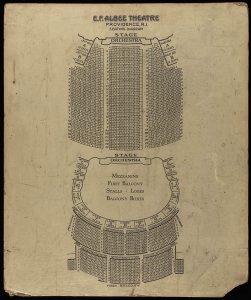
Dissertations, as original work, often incorporate primary sources from special collections and archives. Each collection and archive will have its own procedures and policies concerning reuse of materials, usually related to copyright and any donor and gift agreements that are in place related to a collection. When working with archival sources, here are some best practices to keep in mind.
-
- Be sure to secure permissions for reuse. Archival finding aids may provide information on copyright and reuse. Here are a few examples of collections and how they recommend handling copyright inquiries.
-
- Copyright restrictions may apply. This is perhaps the most common statement regarding copyright, because many collections will not have a clear copyright status across the entire collection. Some items may be public domain while others are under copyright and in some cases, copyright status may be impossible to determine with certainty. Consulting with curators can help a researcher determine the best path forward for securing reuse permissions. Example: Emily Martin Collection, Conditions Governing Use
- Copyright not held by collection. Very often, an institution will hold a collection but not the copyright for the materials in that collection. In this finding aid, Duke University states that they hold the copyright for University records, but for all other materials copyright resides with the authors and descendants. In these cases, the researcher is responsible for contacting the copyright holder on their own. Sometimes the archive can provide contact information, other times researchers will have to locate that information on their own. When contacting a copyright holder, be as clear as possible about your reuse. Tell them you are writing a dissertation, provide the title (even if it’s a working title) for your document, when you plan to graduate, and EXACTLY what item(s) you wish to use. Don’t ask for permission to use an entire collection and then make your decisions about what you want to use later, be specific with your requests and know exactly what you plan to use and how.
Example: Alice Craven Scrapbook, Use & Permissions (scroll to bottom of page) - Copyright managed or held by collection: Sometimes copyright holders sign over copyright management to a collection when they donate or sell their papers. Photographs from the Friedman-Abeles Photograph Collection at the New York Public Library are managed by the holding institution. Therefore, it’s not surprising that some level of digital access is already available to researchers. However, you’ll notice that if wanting a larger resolution than the original photo, there will be a cost associated. Also notice that NYPL offers a citation tool that researchers can use to cite the object in a preferred manner.
Example: Glynn Turman in the stage production A Raisin in the Sun - Be sure to cite the item. The vast majority of archives will provide a preferred citation for objects in their collections. You can find this information within finding aids or sometimes more generally on information pages for that archive. For example, the preferred citation format for the University of Iowa can be found on this webpage that covers rights, permissions, copyright, and citation.
-
- Use high quality reproductions. It’s tempting to grab a quick screenshot to drop into your document instead of procuring a high resolution image from an archive. However, if you’re using illustrations in your dissertation, they are less effective if they are blurry, pixelated, grainy, or otherwise lacking clarity. For digital, your image should at least be 72ppi and for print, 300ppi (600ppi preferable).
- Be prepared to be turned down or ignored. You may not be able to use every single item you want to reuse in your dissertation. Be prepared to exclude images or other materials that you want to include in case you are unable to secure permissions. Rights holders may deny your request or never reply to your communications. You can always reference an item without including it in the document itself. While this may not be your preference, most documents can still function well without an embedded object.
- Be sure to secure permissions for reuse. Archival finding aids may provide information on copyright and reuse. Here are a few examples of collections and how they recommend handling copyright inquiries.
Images
Many of the same basic rules apply for the reuse of images. Students must obtain permissions from the copyright holder to reprint images in their documents. For some images, rights will held by the creator of the image, but in other cases it may be an organization or publisher that holds the rights. Each image will have a different rights situation, even images made by the same creator! Here are some tips on how to proceed.
- If reusing an image found in a book or other print publication, you’ll probably be working with a publisher to obtain rights, at least in your initial inquiries. You may be referred to a rights management organization or the image’s creator, but it’s often easier to start with the place where you found the image and work your way forward from there.
- If reusing an image found on a website, there should be some sort of information available on the page, usually in the footer, for how to contact the website creator or manager. Be sure to clarify that the website actually holds copyright for the image, in some cases sites will reuse images and not publicize their terms of reuse or they themselves will not have done due diligence when publishing the image.
- If using your own images, like a photograph taken with your mobile phone, be sure that you have permissions from the people or locations in the photograph to publish the image. It is always best to get permissions in writing so you can provide evidence of permissions in an appendix of your dissertation, even if you’re getting that permission from a friend, colleague, or frequent collaborator.
- Again, be ready to step back and remove images for which you cannot obtain permissions. Many times, students have been eager to include images that enhance, but are not essential to illustrating the points of their dissertation. It’s ok if you can’t put everything you would like to in your document, you can always reference the image so that the reader can look at it in the same publication or website where you saw it.
Data, Software, and Code
Your research data, in and of itself, is not copyrightable in the U.S. But you can license it in a way that tells potential users about any restrictions or expectations for reuse and sharing of your data.
First, find out if your research data can be openly shared:
-
- Is your data from human subjects?
-
-
- If so, did the participant consent form give permission for data sharing?
- Have you reviewed data sharing with the Human Subjects Office?
- Are there any restrictions on the sharing of this data?
- Has the data been prepared for sharing? For example, is it anonymized or deidentified? Have all HIPAA identifiers been removed?
- For human subject data and other sensitive/restricted data that can be shared, research funding agencies (like NIH) may require the use of specific repositories. You’ll need to check for award conditions or other requirements by the funding organization.
- In other cases, where a domain repository for restricted access data is not available, a data use agreement may be required to share the data with someone external to UI.
- Are there any other restrictions or considerations about sharing the data openly?
- If all of the above have been addressed, or none of them apply to your data, we strongly encourage you to publish your data in an appropriate domain repository, if one exists, or by depositing data in IRO.
-
License Options
If your data can be openly shared, we suggest using Open Data Commons (ODC) licenses when publishing your data. There are three versions, each with different requirements on what end users can do with your data. Learn more at the website for Open Data Commons.
If you have software, code, and/or scripts that should be shared in parallel with your data, it’s a good idea to attach a license to those, too. See more information about licenses for code and software.
Figures and Tables
It is permissible to reuse figures and tables from previously published works in your thesis or dissertation, but you need to get permission from the copyright holder, include proper attribution in the caption, and cite the original in your reference list.
Permission
To get permission of the copyright holder, go to the article on the publishers website and look for a link to Rights and Permissions. This often leads to a RightsLink form:
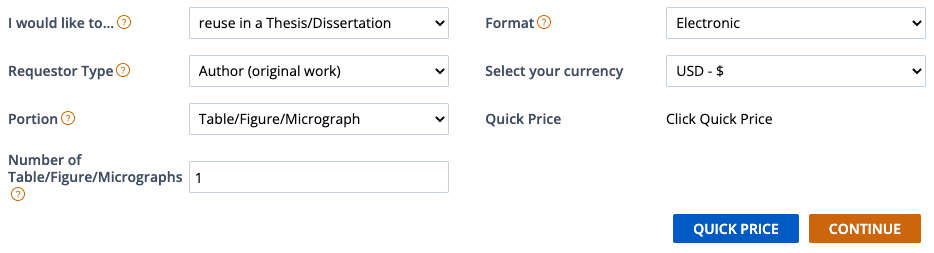
- I would like to… reuse in a Thesis/Dissertation
- Requestor Type: Author (original work)
- Portion: Table/Figure/Micrograph
- Number of Table/Figure/Micrographs: [number of table/figure/micrograph you want to reuse FROM THIS ARTICLE]
- Format: Print or Electronic
- Currency: USD – $
Permission for these types of requests is typically granted at no charge. If you are asked to pay to use the figures/tables, please contact your subject specialist librarian or lib-impact@uiowa.edu for assistance. Print or Save the resulting page as documentation of permission.
If the publisher website does not include a form like this, you’ll have to contact the publisher directly to request permission. You can find contact information on the publisher’s website. Include the following information in your request:
- DOI or citation of the original work in which the figure or table was published,
- The figures and/or tables you want to reuse,
- Where you want to reuse them (i.e. your thesis or dissertation)
If you are unable to contact the publisher or if you need any assistance, please contact your subject specialist librarian or lib-impact@uiowa.edu.
Attribution and Citation
Cite the original work in which the figure or table was published by putting an in-text citation or footnote in the figure or table caption and including it in your reference list. If you need assistance, please contact your subject specialist librarian.
Creative Commons Licensed Works
If the original work is published with a Creative Commons License, you don’t need to get permission to reuse it from the copyright holder, but you do need to give proper attribution. You must display a citation to the original, including the following elements:
- Title
- Author
- Source
- License
Here are some examples of attributions for different types of work:
- “Creative Commons 10th Birthday Celebration San Francisco” by tvol is licensed under CC BY 2.0.
- This work, “90fied”, is a derivative of “Creative Commons 10th Birthday Celebration San Francisco” by tvol, used under CC BY. “90fied” is licensed under CC BY by Joe License.
- Getting Started with Open Educational Resources by Mahrya Burnett, Jenay Solomon, Heather Healy is licensed under a Creative Commons Attribution 4.0 International License, except where otherwise noted.
- This video features the song “Desaprendere (Treatment)” by fourstones, available under a Creative Commons Attribution-Noncommercial license (song used in video)
Luckily, you don’t normally have to create your attribution from scratch. You can copy and modify the attribution from the source itself or use a citation tool such as the Open Washington Attribution Builder.