
Unit 6: Don’t be bashful- interrogate that primary research!
16 Paradigms Extended (added per request)
Created just for the Fall 2023 Methods class!
Paradigm
- Refers to a few overlapping ideas
- A way of seeing and acting on reality
- Metaphors: Lens, recipe, box (textbook ex.)
- Starting points of research traditions, but are subject to change through further education or discoveries
- Impacts the fundamental concepts and aims of a field of study
- Paradigms determine how “evidence” is identified in a given discipline.
- Paradigms for this class: Post-Positivist, Interpretivist, Critical Cultural
PARADIGM: POST/POSITIVISM
Buzzwords: Predict, generalize
Ontology: Realist (reality is fixed and measurable)
Epistemology: Objective, One truth (we can know and study objective reality)
Axiology: Value-free
Methodology: Quantitative
PARADIGM: INTERPRETIVISM
Buzzwords: Explore, understand, & interpret
Ontology: Social constructivist (reality is both orderly and chaotic)
Epistemology: Subjective, Multiple truths (co-created realities)
Axiology: Value-laden
Methodology: Qualitative
PARADIGM: CRITICAL, CRITICAL/CULTURAL
Buzzwords: Power, voice for marginalized peoples
Ontology: Social constructivist (realism shaped by outside forces)
Epistemology: Subjective, Multiple truths (based on values and contexts)
Axiology: Value-laden
Methodology: Qualitative
Detailed Chart
Positivism and Post Positivism can be very hard to distinguish, so unless it is an exam question we show you in the book, we do not test your ability to tease them apart. 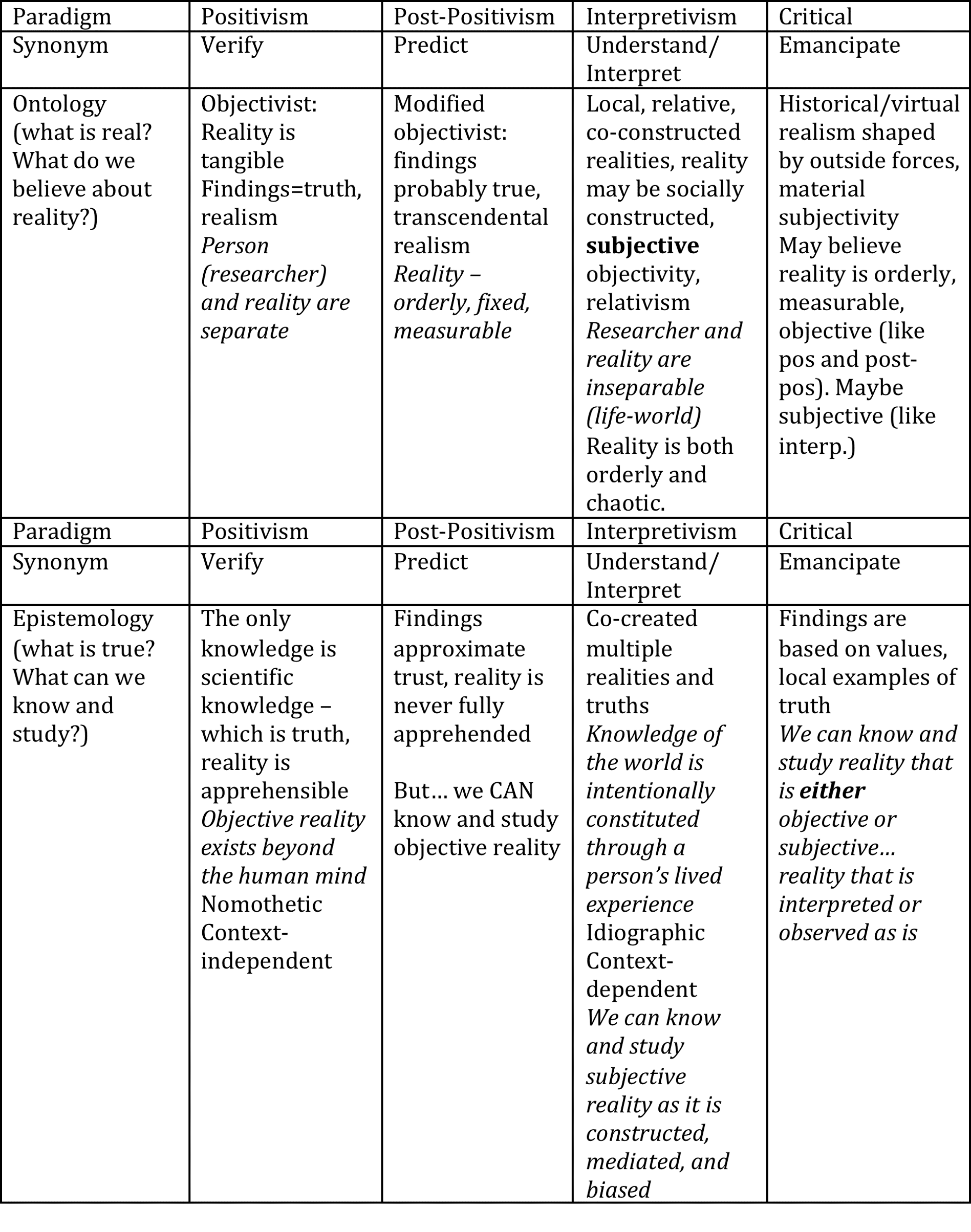
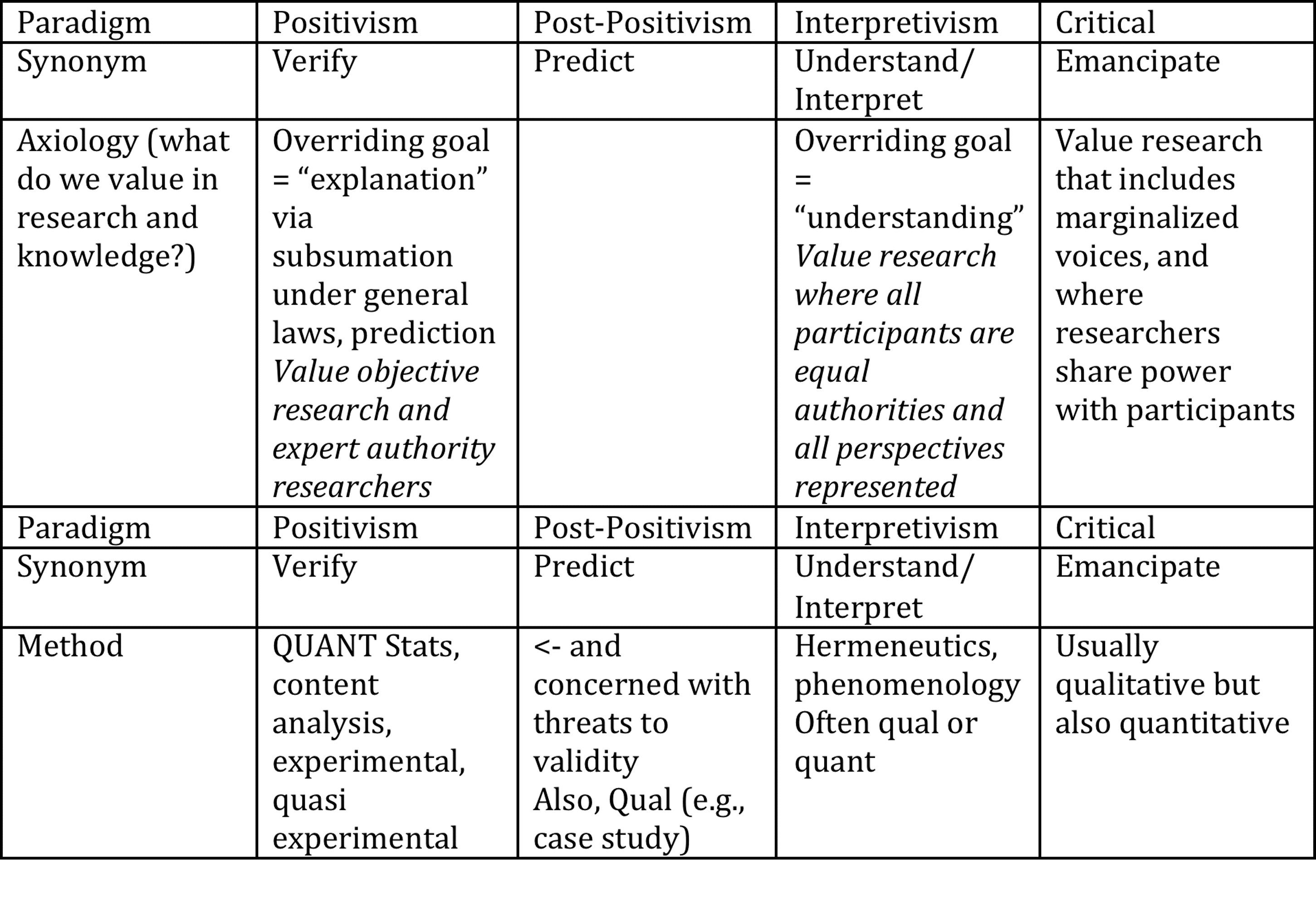 Wait, it sounds like critical is…all the things?!
The critical paradigm is actually very metatheoretically adaptable.
Except, in the communication discipline where only subjective truths and realities tend to be applied. Here is an example of the critical paradigm that is ‘more like’ positivism or post positivism:
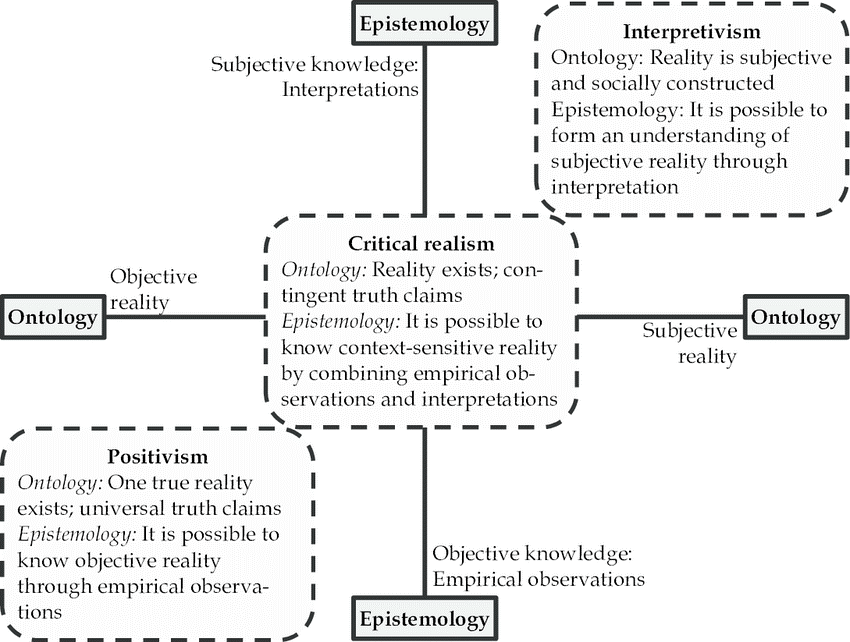
In the communication discipline, the tendency is to focus more on subjective ologies, and therefore, in the communication discipline, critical scholars DO NOT emphasize the need for empirical evidence to prove truth. In fact, they often think empirical evidence is antithetical to the critical paradigm. They control scholarship, through publication, based on their interpretation of the critical paradigm.
There are SO many ways to think and talk about these metatheoretical issues.
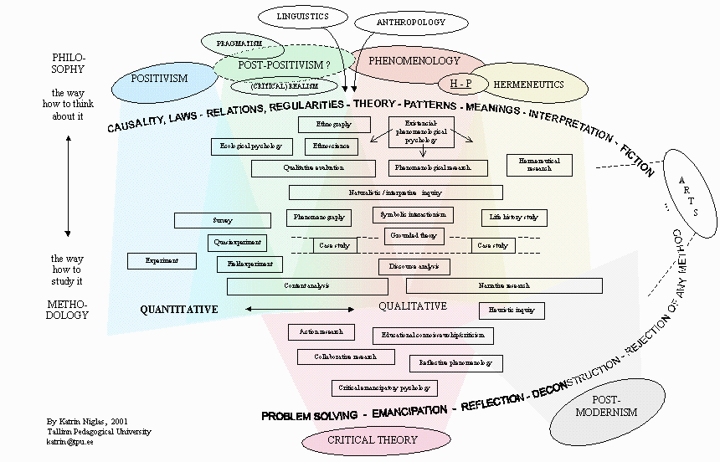
The goal of this class is to present some that are dominant in the social scientific paradigm (post/positivism, interpretivism) or related to the construction of the social scientific paradigm (critical).